
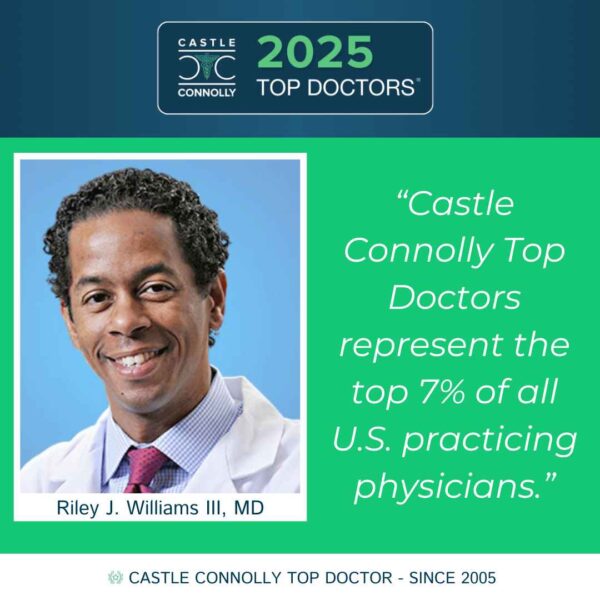
Riley J. Williams, III, MD is once again named as a Castle Connolly Top Doctor!
Receiving the Castle Connolly Top Doctor designation is a distinguished achievement that highlights Dr. Williams’ commitment to exceptional patient care, clinical expertise, and leadership in Orthopedic Surgery. This recognition is granted through a meticulous selection process involving peer nominations, thorough research, and a review of professional accomplishments. Dr. Williams is once again being honored with the title of Top Doctor, an award he has won 20 years in a row!
Congratulations, Dr. Williams, for being among the top 7% of practicing physicians in the United States!
You can see Dr. Williams’ Award here: Castle Connolly’s Top Doctors, 2025
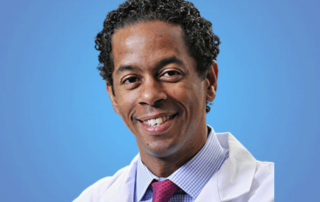
 From The Hospital for Special Surgery (HSS) Via Instagram:
A trailblazer in sports medicine, Dr. Williams specializes in knee, shoulder, and elbow surgery, with a focus on knee ligament repair and cartilage reconstruction after sports-related and orthopedic injuries. He performed the first knee cartilage transplantation in New York at HSS in 1998. He is also a trusted medical expert for elite athletes and professional teams worldwide, serving as Medical Director and Head Team Orthopedic Surgeon for the Brooklyn Nets, New York Liberty, and New York Red Bulls MLS. He also leads the FIFA Medical Center of Excellence at HSS and was recently appointed the New York Chief Venue Medical Officer for the FIFA World Cup in 2026.
Dr. Williams is honored, humbled and excited about this very prestigious role:
“I’m incredibly honored, humbled and excited to step into this new role,” said Dr. Williams, “It is a career milestone, and I owe a deep debt of gratitude to my peers and colleagues for their profound influence over the years.”
Highlights from Business Wire:
Focus on Fostering Greater Collaboration:
Leading a multidisciplinary team of more than 60 clinicians across HSS locations in New York, Connecticut, New Jersey and South Florida, Dr. Williams will focus on fostering greater collaboration among sports medicine surgeons and physicians, with the goal of taking patient outcomes, research and education to new heights.
HSS is Home to the World’s Greatest Talent:
“The HSS Sports Medicine Institute is home to the world’s greatest concentration of talent in the field. Dr. Williams is the right leader for their next chapter,” said Bryan T. Kelly, MD, MBA, HSS President & CEO. “His passion for performance, recovery and collaborative care will help the future of sports medicine and deliver outstanding results for our patients.”
Dr. Williams, Outstanding in Orthopedic Sports Medicine and Surgery:
Dr. Williams attended Yale University and is a graduate of the Stanford University School of Medicine. He then completed his residency in Orthopedic Surgery and a fellowship in Sports Medicine and Shoulder Surgery at HSS, before starting his practice. Dr. Williams has published over 141 peer-reviewed research papers over his career. With hundreds of invited lectureships and several notable teaching awards over his career, he is widely regarded as a key opinion leader in the field of Sports Medicine.
Dr. Williams is a member of the American Academy of Orthopedic Surgeons, the American Orthopaedic Society for Sports Medicine, the International Cartilage Regeneration and Joint Preservation Society, the Orthopaedic Research Society, American Shoulder and Elbow Surgeons and the NBA Physicians Association.
See full press release on Businesswire
Congratulations Dr. Riley J. Williams, III!
Special congratulations to Dr. Williams for being appointed to one of the most prestigious positions in the Sports Medicine world!

Dr. Riley Williams was recently named as the Venue Chief Medical Officer for the FIFA World Cup 2026
Dr. Williams will be a key member of the FIFA26 Medical Services team, and work in close collaboration with the Medical Tournament Lead and other key individuals responsible for delivering the medical services designed to provide rapid access to emergency care in time-critical situations by a combination of healthcare professionals and ambulances covering venues, events and participant groups on-site or stationed remotely.
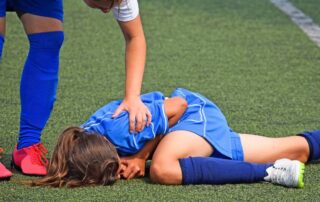
Dr. Riley Williams was recently highlighted for his surgical skills, repairing an ACL.
In this video, courtesy of CNN, Meredith Speck, a patient of Dr. Williams, is part of a growing list of female sports athletes who are sustaining ACL injuries on the soccer field. Dr. Williams was proud to be featured in this video (at :39) performing her ACL operation.
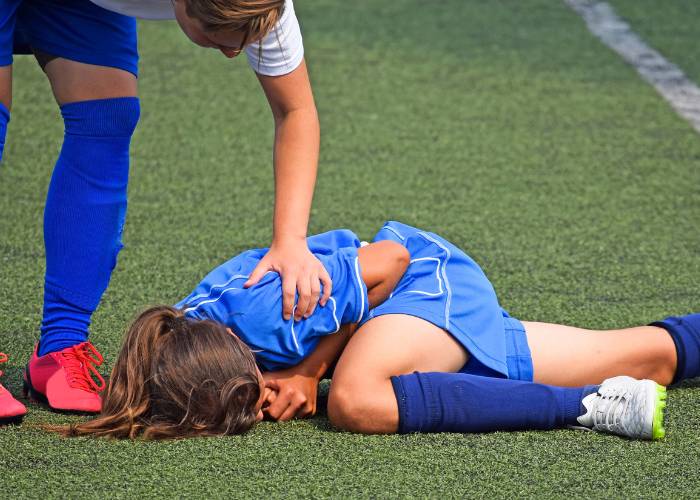
Women’s Soccer is one of the sports that has all the makings of an ACL injury waiting to happen, especially in females since they are 3-4 times more likely to experience this injury than their male counterparts.
Why are women more susceptible to ACL tears?
Here are a few reasons, outlined in the video:
-
Hormones:
- Female hormones, such as estrogen, progesterone and relaxin can all have an effect on the laxity, or stretchiness of all ligaments in the body, not just in the knee. For female soccer players, this becomes important because the looser the ligament, the more likely it is to stretch under pressure, this limits the stability of the knee and can allow the tibia to slide out in front of the femur.
-
Femoral Notch:
- The femoral notch, where the ACL is located, is genetically more narrow in females and in males. This narrow space makes the ACL more prone to injury because the knee ligament can be pinched between the femur and the tibia.
-
ACL is Smaller:
- Men genetically have a larger, stronger ACL
-
Greater Q-Angle:
- A greater Q-Angle (as shown in the video) allows almost a knock-kneed appearance for women, which makes the ACL more vulnerable to injury.
How can women help prevent an ACL injury or tear?
Strengthening and conditioning in the correct way is important in keeping a healthy ACL. As the video shows, a focus on strengthening the hip and thigh muscles can provide stability to the knee and prevent injury. Body mechanics are also an important aspect of a healthy knee, especially when learning to land, pivot or change directions. Finally, a proper warm up and cool down period can help keep the knee and its surrounding muscles in good health.


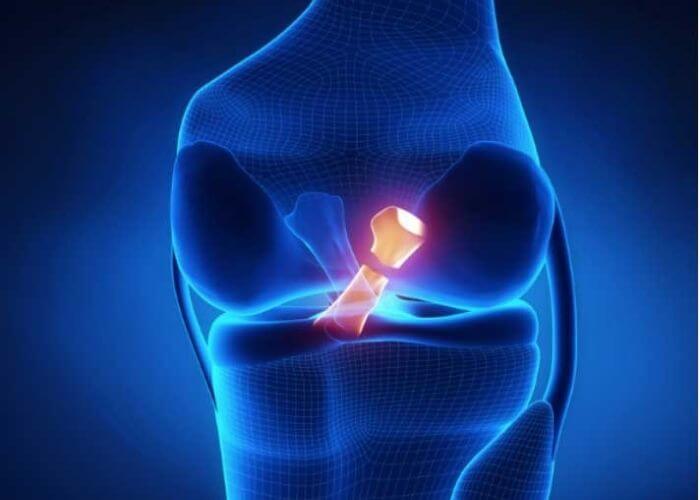
What is the difference between ACL repair and ACL reconstruction?
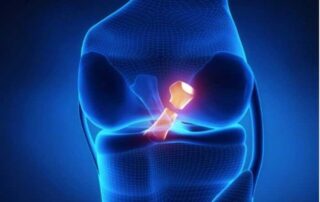
Anterior cruciate ligament (ACL) injuries are a significant clinical problem for individuals who participate in pivoting sports (i.e. soccer, lacrosse, American football, basketball, downhill skiing, tennis, pickleball). Knee instability associated with an ACL tear may predispose patients to meniscal injuries, cartilage damage, and eventually osteoarthritis.
The current gold standard in the treatment of ACL injuries is ACL reconstruction. ACL reconstruction utilizes an alternative ligament or tendon source to replace the injured ACL.
Primary ACL repair is currently a hot topic in Orthopedic Surgery and Sports Medicine. It is important for the ACL-injured patient to have a solid understanding of the benefits, outcomes, and risks of a repair vs a reconstruction as they decide how best to treat their specific injury. Doctor Riley J. Williams provides diagnosis as well as surgical and nonsurgical treatment options for patients in Manhattan, Brooklyn, New York City and surrounding areas who need an expert repair or reconstruction of their ACL.
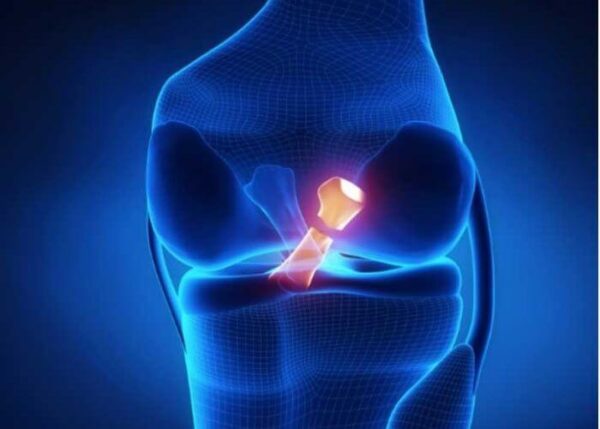
What is primary ACL repair?
Primary ACL repair involves suturing the torn ACL back together. ACL repair does not utilize a donor graft source. The torn ends of the ACL are trimmed to remove any frayed or damaged tissue, carefully aligned, and sutured together. Alternatively, the torn ACL may be reattached to the bone on which it naturally inserts using sutures and bone tunnels., ACL repair configurations may be reinforced, synthetic scaffolds, biological adjuncts, or other external devices.
Why is there recent renewed interest in primary ACL repair?
Advancements in surgical techniques and technologies have made primary ACL repair more feasible. ACL repair was thoroughly studied in the 1980s and replaced with more modern and effective ACL reconstruction techniques. Surgeons who recommend the ACL procedure as an alternative to ACL reconstruction point out the potential for a shorter recovery time, the idea of preserving a patient’s natural ligament tissue and reduced risk of donor site morbidity as the procedure does not involve harvesting donor tissue graft. Moreover, offering patients the option of ACL repair is also a way for Orthopedic Surgeons to differentiate themselves from other knee surgeons.
Does primary ACL repair have a lasting positive outcome?
While primary ACL repair can be a viable option for a small subset of patients with ACL tears, it is not suitable for most patients, especially those patients who actively participate in pivoting sports. The clinical success rates of the ACL repair are inferior to ACL reconstruction; moreover, revision rates of ACL repair patients far exceed those observed for ACL reconstruction patients. Failure rates of ACL repair procedures are especially high in young patients (age less than 30 years) who participate in ballistic, high demand sports. Patients considering primary ACL repair should seek a second opinion from an orthopedic surgeon who specializes in the treatment of ACL injuries to confirm the appropriateness of ACL repair in their specific circumstance.
Doctor Williams’ practice specializes in the treatment of knee ligament injuries; he performs a high volume of both primary and revision ACL surgeries. Unfortunately, many of these revision ACL surgeries are performed on patients who underwent primary ACL repairs from other practices. ACL repair does have a place in the continuum of ACL treatment options following ACL injury. It is a reasonable option in lower demand, older patients.
Facts about primary ACL repair surgery?
- Primary ACL repair is typically only considered for patients with a proximal (femoral) avulsion tear (the ligament is pulled away from the bone); other tear configurations (i.e. mid-substance) are less optimal for current ACL repair methods.
- Suturing a torn ACL back without causing additional damage to the ligament requires a high level of surgical skill and expertise, making it potentially more challenging than ACL reconstruction surgery.
- The success rates of primary ACL repair are generally poorer than those of ACL reconstruction, particularly for athletes or individuals with high activity levels. The repaired ACL is more prone to re-tearing and may not provide the same stability as a reconstructed ACL.
- While a shorter recovery time is often one of the benefits touted for primary ACL repair, the recovery time is often actually longer than after ACL reconstruction because the repaired ACL needs time to heal and regain strength. Oftentimes, ACL repair patients must be immobilized early in the rehab process to facilitate ligament healing. This can result in knee stiffness and loss of leg strength.
- The long-term results and durability of current ACL repair methods are unknown.
Is primary ACL repair less expensive than ACL reconstruction?
ACL repair is not less expensive than ACL reconstruction.
Does primary ACL repair surgery take less time than ACL reconstruction?
No. Skilled ACL surgeons should be able to complete a primary ACL repair or ACL reconstruction in under an hour.
What is the take home message for ACL repair vs reconstruction?
Although ACL repair is an emerging approach in the treatment of the ACL injured patient, clinical results and revision rates of primary ACL repair are inferior to ACL reconstruction. Patients should consult with a surgeon well-versed in the treatment of these injuries before moving ahead with either ACL repair or ACL reconstruction.
ACL Tear Repair or Reconstruction Surgeon

If you participate in pivoting sports, or in activities that involve jumping or quick stopping, you are at risk of injuring or tearing your ACL (anterior cruciate ligament) in your knee. The decision to repair or reconstruct the ACL depends on a lot of different factors and varies per individual. Patients who want to return to sport should weight their options carefully. ACL surgeon, Doctor Riley J. Williams provides diagnosis as well as surgical and nonsurgical treatment options for patients in Manhattan, Brooklyn, New York City and surrounding areas who have sustained an ACL injury. Contact Dr. Williams’ team today!